Tag

Carry

Bible

What We Carry: The Inner Life That Shapes Outer Ministry

By Devotional
Bible

There is a quiet mystery at the center of ministry that we don’t often name—not because it is unimportant, but because it runs beneath everything else we do. It is the reality that what we carry within us inevitably shapes what we carry into the world. Long before strategies or structures, there is a hidden inner life that becomes the foundation of all ministry.

This truth is both sobering and freeing. Sobering because our inner life matters more than we sometimes acknowledge; freeing because it reminds us that God never asked us to generate ministry from our own strength. He asked us to carry Christ.

When I reflect on carry, I think of Christ entering the world through the humble posture of being carried—embodied, present, near. I think of Paul’s longing for Christ to be “formed in us,” dwelling in our inner being. Carrying is not merely something we do; it is something we become. It is the slow, interior shaping of the Spirit that fills our outer ministry with life.

Outside of Every Home for Christ, I occasionally sit with people in the tender places of their stories. I don’t speak about this often, because it isn’t my primary calling here, but the posture of that work has deeply formed me. In counseling, you learn how to sit with someone in their burden without absorbing it as your own. You learn presence, compassion, and the sacred tension of being fully with someone while entrusting the weight of their life to Jesus.

That posture has shaped the way I understand carrying Christ in ministry. We are invited to be attentive and present—to the joys, pressures, and needs around us—without holding everything ourselves. We carry Christ, not everyone else’s weight. And because Christ lives in us, what we carry into conversations, decisions, and relationships is His steadiness, His peace, and His compassion.

The Inner Life Shapes How We See

When our inner life is anchored in Christ, we begin to see differently. People become beloved, not burdens. Challenges become invitations rather than interruptions. Our limitations become places where grace meets us, rather than flaws we must hide.

A leader who tends to their inner life carries a softened, discerning presence. Their peace subtly shifts the atmosphere around them. Their ministry flows not from striving, but from being deeply rooted in Jesus.

The Inner Life Shapes How We Lead

Outer ministry asks us to communicate, decide, create, guide, and solve problems. But the inner life invites us to slow down, listen, surrender, and depend.

When these two worlds are integrated, leadership becomes less reactive and more responsive. We stop trying to carry outcomes that belong to God. We make decisions from a grounded place. Our teams experience us not as hurried or heavy, but as steady, attentive, and trustworthy.

Even in my limited counseling work, I’ve learned the importance of pausing before responding—checking what I’m actually carrying inside. That same discipline has become crucial in leadership. If I’m overloaded internally, it shows. But when my inner life is tended, the way I lead becomes lighter, more gracious, and more aligned with the heart of Christ.

The Inner Life Shapes What We Carry to the Nations

Every Home for Christ’s mission is profoundly relational. We are not simply distributing tools or executing strategies. We are carrying Christ to people—person to person, home to home.

And we cannot carry outwardly what we have not first received inwardly.

A leader whose inner life is rooted in Jesus naturally carries hope, gentleness, conviction, and wisdom into their ministry. Their presence itself becomes a testimony to the gospel.

A Final Invitation

As we reflect on Carry, perhaps the most important question is not, “What am I producing for God?” but “What am I carrying with God?”

Before we carry Christ into homes and nations, He must be carried within us. Ministry begins not with our action, but with His presence forming us from the inside out.

May we be leaders whose inner lives are spacious enough for Christ to dwell richly—and may everything we carry outward flow from that sacred, hidden place where He is still shaping us.

smiles

See People: The Gift of Attention in a Distracted World

By Devotional
smiles

The other night, our family went out to a small Italian restaurant in our neighborhood—a rare pocket of calm in the full pace of life with work and three kids. We slid into our seats, placed our order, and without even noticing, my husband and I both reached for our phones. I couldn’t tell you whether we were answering a text, checking a football score, or mindlessly scrolling. What struck me later was how natural it felt to be distracted from the very people I love most in the world.

Thankfully, our ten-year-old son interrupted the drift. Insightful and emotionally intuitive, he announced that we were going to play a game called Get Closer. Using an app by the same name, he began asking questions that invited each of us to share. One question stopped us in our tracks: “Who was the teacher who impacted you most in your life?”

For the rest of the meal, we told stories, listened closely, and opened ourselves to one another. I was reminded how endlessly fascinating the people closest to me truly are—and how much there still is to discover when I am actually present. I also felt the sting of realizing how often I miss these moments because of distraction.

I know I’m not alone. We may be living in the most attention-challenged era in history. The phrase attention economydescribes the world we now inhabit—a world where our capacity to notice is monetized and manipulated. Most of us have experienced this: you pick up your phone to make a call, tap a notification, and suddenly twenty minutes have disappeared in a blur of scrolling. Researchers warn that our attention spans are shrinking under the weight of constant stimulation.

Yet in a time defined by distraction, attention has become a rare and radical gift. To be physically present but emotionally elsewhere has become normal. Which means that offering someone our full presence—truly seeing them—carries incredible weight.

Recently, I found myself returning to a familiar story in Mark 10. A rich young ruler approaches Jesus and asks what he must do to inherit eternal life. Jesus lists several commandments, and the young man eagerly responds that he has kept them all since his youth. Then comes a striking line from The Message: “Jesus looked him hard in the eye—and loved him.”

Before Jesus said anything challenging or invited the man into deeper freedom, He saw him—and loved him. This pattern appears throughout the Gospels. Jesus pays careful attention to children His disciples try to dismiss; to a woman dragged before Him in shame; to suffering outcasts pushed to the edges of community; to lepers; to Bartimaeus calling out from the roadside. At the height of His ministry—surrounded by demands, expectations, and crowds—Jesus consistently slows down for the one person in front of Him, especially the one society overlooks.

As a trauma practitioner, I sit each week with people carrying profound pain. I draw from years of training, but again and again I see that what many people long for most is simple: someone who will sit with them, listen without judgment, and offer compassionate presence. Many have gone most of their lives without that kind of attention from anyone. When it finally arrives, it often marks the beginning of deep healing.

In a world saturated with noise, those of us seeking to carry the heart of Christ are offered a meaningful opportunity. Our attention—limited and precious—is one of the most powerful gifts we can give. To offer attention is to offer presence. It looks like asking open-hearted questions, noticing both pain and joy, and honoring the stories entrusted to us. It means resisting the impulse to fix or evaluate and choosing instead to witness with compassion.

Perhaps it begins with the smallest of choices: putting the phone down at a restaurant table, looking into the eyes of the person across from us, and allowing ourselves to be surprised again by the wonder of another human soul.

Attention will never be effortless in a distracted world—but it is transformative. When we choose to see—truly see—we participate in the healing way of Jesus, who attends to the overlooked, the ordinary, and the beloved right in front of Him.

Maybe that is the invitation for us now: to reclaim the simple, sacred practice of paying attention. To be people who notice. People who linger. People who look one another in the eye—and love.

Namibia

CARRY – When the Pandemic Is Positive

By Devotional
Namibia

This year, the global family of Every Home celebrates its 80th anniversary under the watchword CARRY. The story of the gospel’s movement across Africa can best be described as viral. The metaphor of the gospel spreading like a virus is both striking and fitting. It is rare that we view something good through the lens of epidemiology, yet in a world that has just emerged from the scourge of a global pandemic, the word Carry powerfully evokes that imagery.

We are Christ Carriers—infected by the gospel. The likelihood of transmission through any interaction with us is high. We are a highly contagious evangelism community, and in every encounter with a Christ Carrier, no one leaves untouched.

Today, there are more than 734 million Christians in Africa. Around the year 1900, there were only about 10 million. That means nearly 31% of all believers worldwide now live in Africa, making it home to the largest Christian population on the planet. Every single conversion points to a carrier. This is why the comparison to a virus is so fitting—it illustrates the rapid, organic spread of the gospel from person to person.

Two months ago, I was in Lesotho with Erick Todd and a media team, following the story of the gospel in the remote mountainous villages of Qacha’s Nek. These communities are often described as unreachable—isolated by agonizing terrain. But as we’ve learned, viruses know no borders.

The story there begins with King Moshoeshoe, founder of the Basotho nation. In 1833, he invited French missionary Eugène Casalis to help him acquire weapons from Europe and form alliances with Britain. In Moshoeshoe’s own memoirs, he writes that conversion was never his goal. But when you encounter a Christ Carrier, unexpected things happen. Instead of weapons, Moshoeshoe received baptism—and a Christian nation was born. Today, Every Home carriers in Lesotho continue that legacy, taking the gospel daily on horseback from village to village across those arid mountains.

The history of the gospel across Africa echoes with similar stories. From North Africa emerge names like Tertullian and Augustine of Hippo—single carriers whose presence altered the eternal destiny of entire societies. Moving east to the Horn of Africa, we meet Frumentius, a Greek Christian who led Ethiopian King Ezana to Christ in Aksum around 327 CE. That contagion continues today, as Ethiopia experiences some of the most remarkable exponential gospel growth through Every Home’s witness.

In the late 1490s, Franciscans from Portugal became the first to bring the gospel to Sub-Saharan Africa, landing in the Congo. They, too, were Christ Carriers. Today, Sub-Saharan Africa ranks among the regions with the highest conversion rates in the world.

Even the physical address of our continental offices in Southern Africa tells this story—51 Livingstone Avenue, named after David Livingstone of Scotland. Just a few streets away is Robert Moffat Avenue. These missionary explorers arrived in the late 1800s, but the major gospel outbreak occurred in the 20th century, as decolonization swept across Africa and Africans emerged as a powerful, independent force in Christian missions.

The parallels between Christ Carriers and viral outbreaks are striking—not only in speed of transmission, but also in transformational impact. The bubonic plague of 1665 wiped out a quarter of Europe’s population in just 18 months. Likewise, the statistics of gospel saturation, baptismal numbers, and response ratios across Africa today can feel overwhelming. It’s viral.

Consider the Himba people of northern Namibia. In the early 2000s, Dr. Douglas Mudimba, a professor of veterinary science, was asked by the Namibian government to serve a nomadic tribe whose wealth was measured in livestock. The Himba owned no houses, held no bank accounts, and possessed no stocks—only animals. Their veterinarian, however, was also a Christ Carrier. While caring for their livestock, he shared a message of redemption. Today, an entire tribe once rooted in animism has been transformed. New churches are emerging weekly throughout Kaokoland.

Or take the story of the Ba-Tonga people in the Gwembe Valley along the Zambezi River. Once considered isolated and unreached, their story has changed dramatically. Our original goal was to preach the gospel, but as we encountered people, their urgent needs became clear. We responded by demonstrating God’s love—initiating food security projects, introducing irrigation technology, and improving living standards. As Christ Carriers, we saw people, showed love, and spoke the Word. Today, more than 100 churches line the valley.

Remember the metaphor: a virus infects and transforms its host. We carry Christ, and those who receive Him become carriers themselves. Just as a virus invades and saturates its host at the cellular level, the gospel transforms the very core of humanity. When Christ Carriers move on, the newly infected continue to multiply. What remains are the symptoms—righteousness, peace, eternal hope, and joy.

“For if anyone is in Christ, he is a new creation; the old has passed away—behold, the new has come.”

walking

Carry and Be Carried: Learning to Walk with Jesus and Each Other

By Devotional
walking

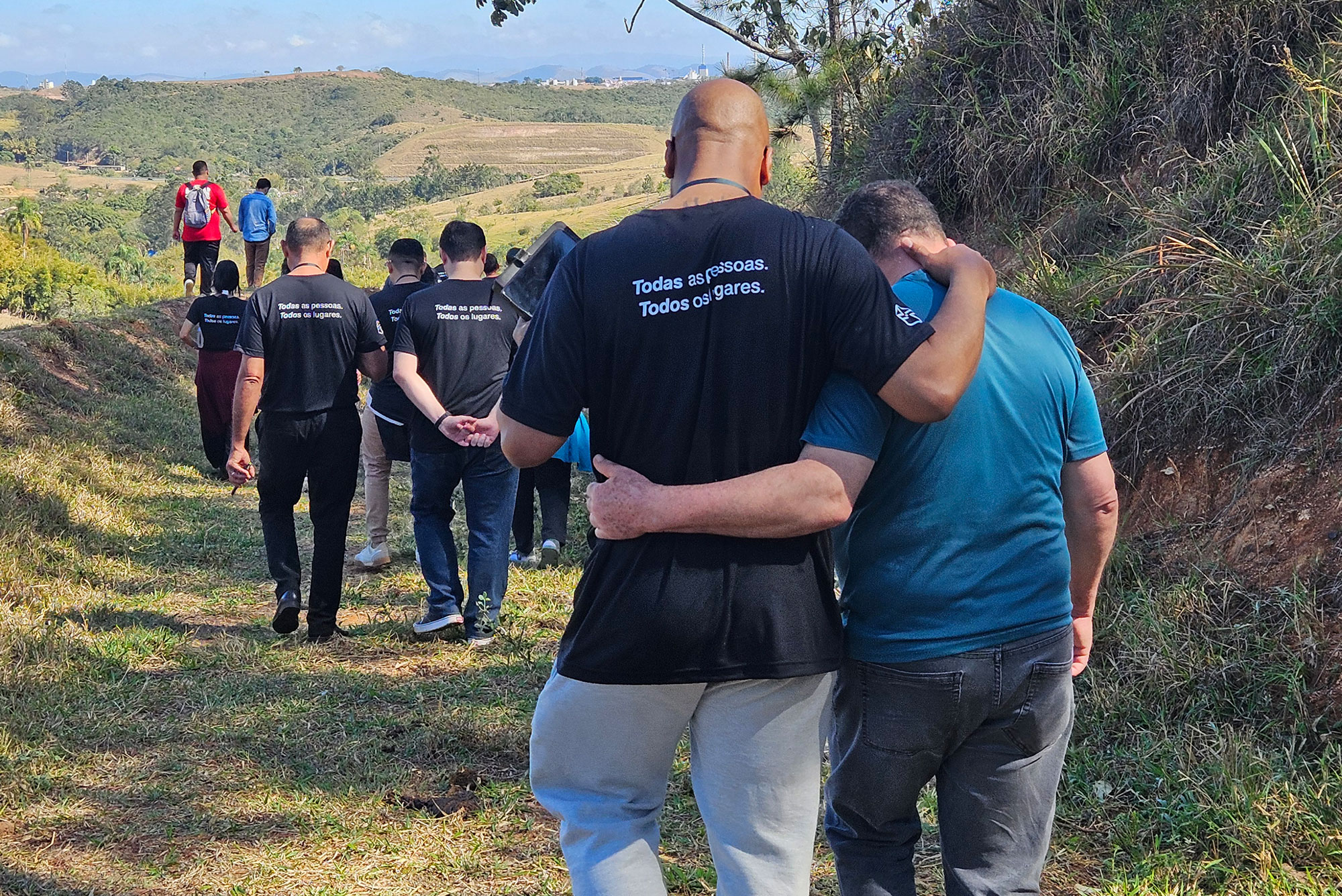
There are moments on our journey—moments when the path grows difficult and the weight of our limitations presses down on our shoulders…and even our ankles. Following Jesus does not spare us from these moments. The invitation into formation in the image of Christ is not a solitary road. It is a shared pilgrimage—a painful and beautiful journey in which we walk with Jesus and with one another, carrying and being carried along the way.

Years ago, while backpacking in the mountains with close friends, I learned this truth in a visceral way. Near the end of the trail, just a short distance from the car, one of my dear friends badly sprained his ankle. He was unable to walk the final stretch due to the pain. One thing became immediately clear: someone would need to carry him the rest of the way.

One friend hoisted all of our backpacks onto his shoulders—no small task—while I lifted our injured friend onto my back. Step by step, we made our slow, determined journey toward the car together. It wasn’t graceful. It wasn’t efficient. But it was exactly what the moment required.

Looking back, that experience has become a lens through which I understand the Christian life. No one questioned whether the extra weight was “fair.” No one tried to hide their weakness. Vulnerability simply became the doorway to love. Carrying one another wasn’t a strategy—it was the only response that made sense.

Scripture reminds us that we are called to carry one another’s burdens, and in doing so, to fulfill the way of Christ (Galatians 6:2). As we choose this way, Christ is present—carrying us as we carry each other. He meets us when we cannot walk on our own. He meets us when we are willing to admit our limits. And as He carries us, He teaches us how to carry others with the same gentleness, patience, and commitment.

Our shared mission flows from this place of vulnerability. We walk together not as people who have everything figured out, but as people who know they are loved, carried, and redeemed by Christ. And through a community willing to walk vulnerably with Him and with one another, Christ continues His work of healing and restoration in the world.

May we become a people unafraid of vulnerability.
A people known by love.
A people who refuse to leave anyone behind.

May we be a people who carry—and are carried—by Christ as He continues His redeeming work in the world.

prayer

From Seeing to Sending: How Compassion Leads to Multiplication

By Devotional
prayer

There is a moment—sometimes small, sometimes unexpected—when you truly see someone. Not with hurried eyes or half-attention, but with full, quiet awareness that this person is loved by God and placed before you on purpose. In ministry, these moments are easy to rush past because we are focused on goals, numbers, deadlines, or the next emerging need. But I am increasingly convinced that the real work of carrying Christ begins long before action. It begins with seeing.

Seeing is more than noticing. Seeing is compassion. It is the spiritual discipline of allowing another person’s story, fears, hopes, and dignity to matter to you. It is the posture Jesus held so consistently—when He saw the crowds and had compassion, when He noticed Zacchaeus in the tree, when He stopped for a blind man others dismissed, when He welcomed children rushing toward Him. Compassion, as Christ modeled it, is not merely an emotion we feel; it is a way of attending to people with a heart open enough that action becomes the natural next step.

In our work around the world, we often talk about multiplication—more homes reached, more disciples formed, more churches ignited into mission. And multiplication is beautiful. It is holy. But if we’re not careful, multiplication can quietly become a pressure instead of a promise. We begin to believe impact is something we must generate, compare, or control. We start chasing outcomes instead of practicing obedience.

Scripture offers us a deeply freeing truth: multiplication is God’s responsibility, not ours. Our responsibility is faithfulness.

When Jesus speaks of the mustard seed, He isn’t only making a point about size. A mustard seed is tiny—almost forgettable—and yet, biologically speaking, it contains within itself the full genetic design of the tree it will become. Nothing about the tree is foreign to the seed. Everything that will be multiplied later is already present in potential.

This is both sobering and empowering for our ministry. It means that the grand, multiplied work of Every Home—the scale, the reach, the global coordination—contains within it the DNA of the seeds we plant. If the seed is compassion, humility, and faithful love, the tree will reflect those qualities as it grows. But if the seed is hurried, impersonal, prideful, or transactional, the tree will bear that fruit as well.

A defective seed will grow a defective tree.
A Christ-shaped seed will grow a Christ-shaped movement.

This perspective reshapes how we think about scale. We absolutely reach for bold goals at Every Home—and we should. Our mission is global because God’s love is global. But I want to say this clearly: scale is not our primary aim. Scale follows, by God’s grace, from small, consistent, repeated acts of faithfulness. Multiplication follows obedience. The vastness of the tree is simply the natural outgrowth of the DNA present in the seed we choose to sow.

As a father of three, I am constantly reminded that my children imitate my behavior far more faithfully than they follow my advice. We form our children through small, consistent patterns, not grand speeches. Nothing drives me more quickly to humility—and to prayer—than this truth. I cannot shape them by who I intend to be, only by who I actually am. They see it all. And so does our Father in heaven.

Yet it is precisely in this transparent, vulnerable place that God shows us the most grace and grows us the most deeply.

In Matthew, Jesus urges His followers to pray, give, and do good works in secret—trusting that the Father who sees what is hidden will reward it (Matthew 6:1–6). The hiddenness is part of the design. The seed does its deepest work underground, beyond applause, beyond measurement. Only God knows how far a faithful act will travel or how many lives it will one day shelter.

So as we continue leading, serving, and guiding teams across continents, I pray we remain attentive to the kind of seeds we are planting each day. May we see people with compassion. May our actions be faithful, simple, and sincere. And may we trust that the God who designed the mustard seed—and who placed His own DNA of love within us—knows exactly how to turn our small, hidden seeds into trees that offer shade to nations.

prayer

Carrying Peace into Places of Conflict

By Devotional
prayer

When I read this title, global wars come to mind—Russia’s invasion of Ukraine, conflicts in the Middle East, and the immense suffering they bring. Yet the conflicts that affect me most are much closer to home: the daily arguments with those I love. At times, my marriage feels like a battlefield of recurring micro-conflicts with my wife over seemingly trivial matters. For years, I also struggled with my son. His defiance triggered my worst reactions—rage and helplessness—especially when I saw him direct my own aggressiveness toward his sister. Nothing hurts more than realizing you have passed anger and division on to those you love most.

Why do some situations trigger us so intensely while others barely disturb us? Why does my son ignoring me feel unbearable, while far bigger problems leave me completely calm? I’ve learned that the answer often lies in wounds from childhood. We all carry pain from experiences that were too difficult to process at the time. Parts of us hide that pain deep inside, outside our awareness. These unhealed parts—our “inner children”—wait to be triggered. When they are, they take over, causing harm and chaos.

As Galatians 5:17 says, “The flesh desires what is contrary to the Spirit… They are in conflict with each other.” Sometimes the “flesh” of an unhealed part dominates, leading to hostility or even violence.

So how do we bring peace into these conflicts? And what is peace? For some, peace means the absence of conflict. For others, it means mutual respect or justice. For me, peace is forgiveness, acceptance, and healing—born from a sincere desire to understand the other side. True peace requires empathy and compassion. The “other side” may be my son, my spouse, the opposing team—or even my own wounded self.

Jesus told us to love our enemies. Often, however, the enemy is within. C. G. Jung expressed this powerfully when he wrote:

Perhaps this sounds very simple, but simple things are always the most difficult. In actual life it requires the greatest discipline to be simple, and the acceptance of self is the essence of the moral problem and the epitome of a whole outlook upon life. That I feed the hungry, that I forgive an insult, that I love my enemy in the name of Christ—all these are undoubtedly great virtues. “What I do unto the least of my brethren, that I do unto Christ.” But what if I should discover that the least among them all—the poorest of all the beggars, the most impudent of all the offenders, the very enemy himself—is within me, and that I myself stand in need of the alms of my own kindness—that I myself am the enemy who must be loved?

We all have basic needs: safety, acceptance, respect, and love. When these needs are met, we experience peace. When they are not—and we don’t know how to express them—we often react in destructive ways. Marshall Rosenberg captured this truth well: “Every criticism, judgment, diagnosis, and expression of anger is the tragic expression of an unmet need.”

Scripture warns us against judging (Matthew 7:1–2) and against anger (Matthew 5:22), yet we repeatedly fall short (Romans 7:19–25). Jesus also taught that evil comes from within (Mark 7:23)—from what is unhealed, I would add.

In everyday conflict, I have learned to look for unmet needs—mine or the other person’s. When my child lashes out, I no longer see a “bad” child, but a flower in need of water. If I respond with patience instead of punishment and gently seek the fear or need beneath the behavior, reconciliation often follows. If I react defensively, the opportunity for healing is quickly lost.

Behind every hostile reaction lies an unmet need. A wise person does not battle hostility with more hostility but responds with empathy and seeks to uncover the deeper need. Behind every aggressor is someone longing for safety, dignity, or understanding. Punishment does not heal—only love does.

So what is love? John Powell offers a practical definition in The Secret of Staying in Love:

  • Love esteems and affirms the unconditional, unique value of the one loved.
  • Love acknowledges and seeks to fulfill the needs of the one loved.
  • Love forgives and forgets the failings of the one loved.

The willingness to look beyond hostility, to seek the real needs beneath the pain, and to see the world through the eyes of another—these are the keys to carrying peace into places of conflict. This is true in our homes, our communities, and even within our own hearts.

True peace is not the absence of conflict.
True peace is the presence of healing.

Carrying Hope Through Suffering

By Devotional

There are moments in life when faith stops being a concept and becomes a matter of survival—when everything you once considered safe begins to crumble, and all you can do is whisper, “Lord… where are You?”

Through my own journey, and through years of walking with people across the MENACA region, I have learned that faith rarely grows in comfort. It grows in conflict, in the places we never planned to be.

Some time ago, I passed through one of those seasons. A storm struck my life hard, threatening my emotional and family stability. I felt hurt, misunderstood, and unsure how to keep going. There were nights when I could not pray—only cry. Yet in that silence, something sacred began to form.

In the middle of the pain, worship rose. It wasn’t joyful or polished—it trembled. Worship born through tears and broken words. But it was real. And in that raw worship, I met Christ not as an idea I believed in, but as the One who carries.

I discovered that Jesus does not only call us to carry our cross—He carries us through it. I experienced His presence not in a loud or dramatic way, but like a whisper. Like the whisper Elijah heard on the mountain, He was there—quiet, strong, and steady.

The Bible does not hide suffering. It tells the stories of people who walked through deep pain and still held on to hope—a hope that did not erase sorrow or ignore the weight of their trials, but transformed them.

Peter urges us to “rejoice” (1 Peter 1:6). James echoes the same command (James 1:2). First, because our trials are temporary when set against the future that awaits us. Second, because behind every trial there is a redemptive purpose: “your faith, much more precious than gold,” is being refined. And third, because the result of this refining is “praise, glory, and honor” when Jesus Christ is revealed.

Job lost everything, yet declared, “Though He slay me, yet will I hope in Him.” This was not blind faith—it was surrender. It was the choice to keep trusting when nothing made sense.

David, hiding from Saul, poured out his anguish in the Psalms: “Why, my soul, are you downcast? Put your hope in God.” Those words were not written from a place of comfort, but from the darkness of a cave. Faith is not pretending to be strong—it is choosing to look up when everything in you wants to give up.

And then there is Jesus, the perfect image of hope in suffering. “For the joy set before Him, He endured the cross.” Hope carried Him through the agony, and that same hope carries us.

Redemption unfolds when we allow ourselves to be carried by Christ even when everything around us gives us reasons to let go. Hope lives in that defiant decision that says, “I will not give up, because the One who redeemed me has not let go of me.”

Nothing delights the heart of God more than steadfast faith—faith in who He is and in everything He has promised.

Looking back on my own valley, I have realized something: I was not holding myself together—Christ was carrying me. His Word became my refuge. His love became my strength. Many days, all I could do was sit at the piano and weep, and with a broken voice, lift a song of worship—full of tears, but also full of truth and surrender.

That is what hope is: not the absence of pain, but the awareness of His presence within it (Romans 5:3–5).

God does not always change our circumstances, but He always changes us in the middle of them.

That is where hope grows—in surrender, in worship, in endurance. It becomes more than survival; it becomes a testimony.

Christ never carries us just to return us to where we were. He carries us so that we can grow—and so that we can carry His love to others who are hurting.

When you have tasted pain and found His comfort, you begin to see others differently. Their pain is no longer foreign—it becomes familiar. And instead of offering solutions, you offer presence: the same presence that once held you together.

Paul wrote, “We are hard pressed on every side, but not crushed; perplexed, but not in despair.” That is not theory—that is experience. Grace does not always stop the storm, but it keeps us from breaking beyond repair.

Hope is not escaping the storm; it is standing in it, knowing that the One who calmed the sea is still calming hearts.

Not a single tear is wasted. One day, we will understand how the nights we feared would destroy us were actually shaping our faith instead.

Paul called it “an eternal weight of glory beyond all comparison, as we look not to the things that are seen but to the things that are unseen” (2 Corinthians 4:17–18).

Until that day comes, we keep worshiping and breathing through tears and trusting the hands of the One who carries us. Because hope is not something we cling to—it is Someone who clings to us. And His name is Jesus.

Are You A Carrier? Carrying the Gospel Through Everyday, Ordinary Life

By Devotional

Have you ever felt you were being watched by someone you didn’t know, in a setting that made it all the more unsettling?

You’re sitting at the end of an aisle in a packed school auditorium during your child’s annual Christmas play. Hundreds of parents and relatives fill the room. Your eyes drift from the stage to the aisle across from you, four rows ahead—and you notice a man staring directly at you. As soon as he realizes you’ve seen him, he quickly turns away. A few minutes later, curiosity gets the better of you and you glance back. Again, he’s staring—and again, he looks away.

Your instinct might be to jump up mid-performance, confront him, and say, “Hey, do you have a problem?” But of course, you don’t. When the play ends, he disappears into the night, and you’re left wondering why he was watching you at all.

Early in my leadership with Every Home, I once took an evening flight from Los Angeles to the East Coast for a speaking engagement. The flight had a stop in Denver for a crew change before continuing on to my destination.

I was seated in economy, about eight rows behind the galley where a curtain was drawn while a flight attendant prepared a light snack. As I glanced up from my reading, I noticed a head peeking through a small opening in the curtain—directly at me. The moment she realized I had seen her, she dropped back behind the curtain. A few moments later, it happened again. Then again. I began to feel uneasy.

Did she think I was a terrorist? My carry-on had been especially heavy, and I had struggled to lift it into the overhead compartment. Did she think it was a bomb?

About 15 minutes after the snacks were distributed and the cabin was cleaned up, I noticed the same flight attendant walking down the aisle. To my surprise, she stopped beside my row and knelt down in the aisle next to me.

“Excuse me, sir,” she said with concern on her face, “but are you a Christian?”

Startled, I replied, “Yes, I am. Why do you ask?”

“May I sit beside you and talk with you for a few minutes? It’s very important to me,” she said.

I agreed immediately. The flight was only half full, and the two seats beside me were empty.

Before I could say another word, she continued. “I almost didn’t make this flight tonight because I’ve been in deep despair for quite some time. I had decided to end my life in my hotel room in LA, but I heard a voice in my heart telling me I must take this flight.” Through tears she added, “The voice said there would be a Christian on this plane who would help me find my way out of the darkness.”

After wiping her eyes, she went on. “Since we left Los Angeles, I’ve been looking up and down the aisles, trying to figure out who might be that Christian. I didn’t even know what that was supposed to look like. But when I saw you, something inside me said, ‘That’s him.’ I was so relieved when you told me you are a Christian. Can you help me?”

Over the next 30 to 45 minutes, I had the joy of sharing with her how knowing Jesus could change her life and restore a joy deeper than anything she had ever known. When the flight landed in Denver and the crew changed, she left with peace and joy on her face.

That night taught me what it truly means to be a carrier of Christ in everyday, ordinary life. What seemed like just another routine flight suddenly became a divine appointment. The Holy Spirit transformed an ordinary moment into a life-changing encounter for someone desperately searching for hope. And that night, she found that hope in Jesus.

The Apostle Peter captures this calling simply when he writes:
“Always be prepared to give an answer to everyone who asks you to give the reason for the hope that you have. But do this with gentleness and respect” (1 Peter 3:15, NIV).

If you are a Christian, you are a carrier.
Pass it on.

Carry Christ, Not Just Represent Him

By Devotional

Today it has become surprisingly easy to take refuge in the comfort of being called ministers of God and to become trapped in the position of representing Christ. We enjoy how it sounds, how people see us, and how it places us in certain spiritual spaces. Yet there is a quiet and subtle danger: representing Christ from a distance while our hearts slowly disconnect from the living example of the Master. He did not merely speak about the Kingdom; He embodied it. He did not simply teach about service; He wrapped a towel around His waist and washed feet. He did not just mention the brokenhearted; He embraced them, touched them, and walked with them. To represent Him is easy, but to carry Him is costly.

During my annual Bible reading, I found myself drawn again to the book of Revelation, particularly to the message of the risen Christ to the seven churches. One message in particular has shaken my heart: the message to the church of Laodicea. Jesus says to them, “I know your works, that you are neither cold nor hot.” He then reveals the root of their lukewarmness: “Because you say, ‘I am rich, I have prospered, and I need nothing,’ and do not realize that you are wretched, miserable, poor, blind, and naked” (Rev. 3:15–17).

This diagnosis is not a condemnation; it is a spiritual X-ray. The wealth of this church—according to many theologians—was not their greatest problem. Their deepest weakness was the self-sufficiency their wealth had produced. They had learned to function without depending on the Spirit. They knew how to organize, plan, manage, and produce… but they no longer knew how to kneel. Their activity was great, but their sense of need for God had become small.

And I ask myself, with trembling in my soul: does the modern church face the same danger? Is it possible that we have become so professional, so structured, and so technologically equipped that we no longer feel the desperate need for the presence of Christ to carry out His work? Could it be that some of our most well-intentioned efforts are actually building our own kingdoms while we lose sight of the eternal Kingdom?

In many contexts today, there is a growing pressure to have the best programs, the best music, the most modern production, the most aesthetically pleasing auditoriums, and the most innovative strategies. While all of this can be useful and important—and often is—it can also quietly misdirect our hearts into a consumer-driven Christianity, where the believer becomes a spectator and ministry becomes entertainment. But Christ did not call us to impact the world with aesthetic excellence. He called us to impact it with embodied love, deep compassion, and sacrificial service.

This raises a question that echoes like a divine whisper: What kind of Christianity are we presenting to the world? True disciples of Jesus will always be passionate about loving, serving, drawing near to people, touching wounds, and walking with the broken. Representing Christ from a stage is simple; carrying Him into the streets, the home, the workplace, and the inner places of our character is the genuine work of the Spirit.

In my journey serving with Every Home, I have discovered that carrying Christ is not a religious act; it is an internal transformation that redefines how we think, how we see, and how we speak. Carrying Christ means learning to see people through the eyes of Jesus—eyes that do not first judge, but first love; eyes that do not measure a person’s usefulness, but recognize their eternal value.

Carrying Christ also means speaking words of hope even when we do not have a prepared sermon, because hope does not emerge from polished speech but from the abiding presence of Christ in us. Yet this ability to carry Christ does not come from human effort; it is born from intimacy. It arises in the secret place where Christ shapes, corrects, cleanses, lifts, and guides us. Any ministry that is not born out of intimacy eventually becomes empty activism.

What happened to the church of Laodicea was fundamentally a relational problem. Just like the church of Ephesus—and much like the modern church today—they had achievements, structure, results, and a strong reputation. But they had lost their passion for Jesus. And when the passion for the Son is lost, the capacity to reflect His heart is also lost. This is why we find one of the most moving images in all of Scripture: the risen Christ standing outside the church, knocking on the door, longing to enter (Rev. 3:20).

A church full of activity… but empty of Christ.

And here arises a prophetic call—not a call that condemns, but one that awakens: The greatest revival God desires to bring will not be a revival of events, but a revival of the heart. It will not be a movement driven by our strategies, but by our surrender. It will not be powered by our creativity, but by His presence. It will not be sustained by structures, but by a people who are broken and dependent on the Spirit.

I am convinced that the Lord is raising a movement that is truly transformative. But this movement does not begin on a platform, in a conference, or in a planning meeting. It begins in the heart that empties itself of self. It begins in the heart that recognizes its spiritual poverty and confesses, “Lord, without You I can do nothing.” It begins in the humble heart that allows the Spirit to form within it the character of the Son.

This is the call:

Return to Jesus.
Return to dependence.
Return to first love.
Return to the compassion that does not require microphones.
Return to the presence that ignites everything else.

Only when Christ occupies the center of our hearts can we offer the world something more than an image of Him. We can offer His life, His love, and His transforming power.

Representing Him can impress, but carrying Him transforms.
Representing Him may move crowds, but carrying Him changes eternal destinies.
Representing Him makes us visible, but carrying Him makes Christ visible.

Carrying Faith Into The Impossible – When God is present, the impossible retreats.

By Devotional

“Here it’s impossible to do what you’re saying.”

I have heard those words in many countries as we took the first steps to begin EHC’s proclamation ministry. Some places truly are dangerous. I understand the risk and tension involved in serving the Lord in certain environments, but to claim that it is “impossible” is to disregard the One who has promised to be with us. Time after time, we see that as we move forward, God opens paths where none existed. The impossible is precisely the terrain where He reveals His glory.

“Shall a nation be born at once?”—this is a rhetorical question from Isaiah 66:8. On one hand, it points to the natural impossibility of birth without a process that takes time. Yet the implied answer is yes, it will happen—because God is involved in His redemptive work, and His plans move beyond the limits of human logic. When God is present, the impossible retreats. It happened in the past, and it is happening today.

In a single day, a countless multitude of slaves left Egypt as God’s people—a holy nation on their way to the Promised Land.
On the day of Pentecost, three thousand were born again and added to the newborn church—a new identity.
And today, tens of thousands around the world are passing from the bondage of sin into the glorious freedom of the children of God—a holy nation still being formed.

God has chosen us to know Him, love Him, and obey Him: “For we are His workmanship, created in Christ Jesus for good works, which God prepared beforehand that we should walk in them” (Ephesians 2:10). Obedience is the true evidence of faith. To obey or not to obey—that is the question.

The gospel that has been entrusted to us is the power of God to save, transform, and heal everyone who receives it. We stand firm in that conviction, fully aware that the values of the Kingdom of Heaven continue to clash with the values of this world—often making us feel as though we are walking through hostile territory.

In many places, proclaiming the gospel is forbidden. In others, the growing secularization of society and the abandonment of moral values shape laws and regulations that subtly attempt to silence the Christian faith. Light always awakens resistance in the shadows. Even within our own homes, tensions may arise.

So what should we do?
Stay silent?
Step back?
Change the message?
Settle for comfort?
Seek to please people?

No.

The love of Christ compels us. He calls us to be light in the shadows and the fragrance of His presence everywhere we go. And there—when we step beyond what feels safe—we discover that we are not alone. God Himself promises not merely to visit those who love and obey Him, but to dwell in them.

“If anyone loves Me, he will keep My word; and My Father will love him, and We will come to him and make Our home with him” (John 14:23). What a promise—the eternal God making His home in a willing heart.

Our mission, then, does not arise from human effort, but from the love of God poured into our hearts. Remaining in that love gives us strength to persevere, courage to speak, joy to serve, and faith to step into the impossible.

This is why, where others see impossibilities, we see opportunities for God to be God.
Where others say, “It cannot be done,” we hear the Spirit whisper, “Go forward; I am with you.”

Yes—it can be done.

May our lives be a living declaration that the impossible trembles when God is present. And may He find us faithful, brave, and full of His love as we carry His light to every corner of the world.

“You are a chosen generation, a royal priesthood, a holy nation, His own special people, that you may proclaim the praises of Him who called you out of darkness into His marvelous light—who once were not a people but are now the people of God, who had not obtained mercy but now have obtained mercy” (1 Peter 2:9–10).